@

Showing posts with label battery. Show all posts

Friday, February 15, 2013

Vehicle Charging System

Charging System components


Understand your vehicles charging system before you get into parts replacing related to charging system.

CHARGING SYSTEM:


The charging system is a negative (-) ground system that consists of an alternator, a voltage regulator, a charge indicator, a storage battery, wiring connecting the components, and fuse link wire.


HOW ALTERNATOR OPERATES?

The alternator is driven by a belt from the engine. Energy is supplied from the alternator/regulator system to the rotating field through two brushes to two slip-rings. The slip-rings are mounted on the rotor shaft and are connected to the field coil. This energy supplied to the rotating field from the battery is called excitation current and is used to initially energize the field to begin the generation of electricity. Once the alternator starts to generate electricity, the excitation current comes from its own output rather than the battery.


HOW CAR BATTERY GETS CHARGED?

The alternator produces power in the form of alternating current (AC). The alternating current is rectified by diodes into direct current (DC). The direct current is used to charge the battery and power the rest of the electrical system.


WHAT EXACTLY HAPPENS WHEN IGNITION KEY IS TURNED ON?

When the ignition key is turned ON , current flows from the battery, through the charging system indicator light on the instrument panel, to the voltage regulator, and to the alternator. Since the alternator is not producing any current, the alternator warning light will flash. When the engine is started, the alternator begins to produce current, turning off the alternator light. As the alternator turns and produces current, the current is divided in two ways: one part to charge the battery and power the electrical components of the vehicle, and the rest is returned to the alternator to enable it to increase its output. In this situation, the alternator is receiving current from the battery and from itself. A voltage regulator is wired into the current supply to the alternator to prevent it from receiving too much current, which, in turn, would cause it to produce too much current. Conversely, if the voltage regulator does not allow the alternator to receive enough current, the battery will not be fully charged and will eventually drain.


WILL SHORTED BATTERY SHORT THE ALTERNATOR OR NOT?

The battery is connected to the alternator at all times, whether the ignition key is turned ON or not. If the battery were shorted to ground, the alternator would also be shorted. This would damage the alternator. To prevent this, a fusible link is installed in the wiring between the battery and the alternator. If the battery is shorted, the fusible link melts, thereby protecting the alternator.


VOLTAGE REGULATOR?

The voltage regulator is located inside the alternator, and alternator disassembly is required for replacement. Replacement of the entire unit is recommended.

Monday, December 12, 2011

How to Replace Broken Car Battery Cables?

Car battery cables provide power to other electrical parts of the car.If the battery is ok,but its cables are cracked or broken then instead of replacing complete battery,you can replace its cable and make the battery work.
So first inspect and clean the battery cable.

How to Inspect Car battery Terminals?

http://repairhelpcenter.blogspot.com/2011/12/how-to-inspect-car-battery-terminals.html

How to clean car Battery terminals?

http://repairhelpcenter.blogspot.com/2011/12/how-to-clean-car-battery-terminals.html

If the cables looks cracked then replace cables.The procedure to replace car battery cables with details and diagrams is as follows :-----


The positive cable is normally red and the negative cable is black. The positive cable fastens to the battery and the starter solenoid or relay. The negative cable fastens to ground on the engine block. Some manufacturers use a negative cable with no insulation. Sometimes the negative battery cable may have a body grounding wire to help assure that the vehicle's body is properly grounded.
NOTE
Be sure that a replacement cable has sufficient slack to allow movement of the engine on its mount.
The ground cable (usually the negative) should be disconnected first. This is a good habit to follow whenever doing major repairs.
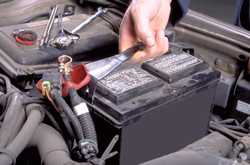
  • Loosen the battery negative terminal clamp.
    • Spring-type cable connectors are removed by squeezing the ends of their prongs together with wide-jaw, vise-gripping, channel lock, or battery pliers. This pressure expands the connector so it can be lifted off the terminal post.
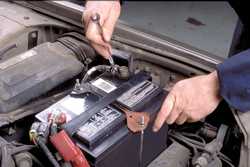
    • For connectors tightened with nuts and bolts, loosen the nut using a box wrench or cable clamp pliers. Using ordinary pliers or an open-end wrench can cause problems. These tools might slip off under pressure with enough force to break the cell cover or damage the casing.
    • Always grip the cable while loosening the nut. This eliminated unnecessary pressure on the terminal post that could break it or loosen its mounting in the battery.


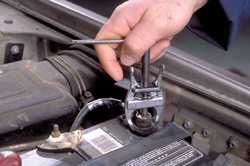
  • Use a terminal clamp puller to remove the negative cable. Prying with a screwdriver or a bar strains the terminal post and the plates attached to it. This can break the cell cover or pop the plates loose from the terminal post.
  • Track the cable to its end and unbolt it from there.


Loosen the battery positive terminal clamp.

Use a terminal clamp puller to remove the positive clamp.
Track this cable to the starter relay or solenoid switch and unbolt it from there.
  • After servicing the cables or battery, install the positive battery cable by reversing the procedure to disconnect it. then install the negative cable. do not overtighten any nuts or bolts since this could damage the post or connector. before attempting to reinstall the old terminal clamp, clean the terminal clamps and enlarge their holes using expanding pliers.
NOTE
Never reverse the polarity of the battery connection. Generally, all vehicles use a negative ground. Reversing this polarity damages the generator and circuit wiring.
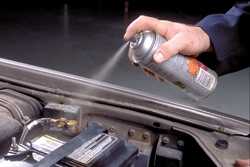
  • Coat the terminals with corrosion preventative spray, then check the job by starting the car. You can also coat the connectors with petroleum jelly or battery anticorrosion paste.


This procedure will help you to replace car battery cables/terminals.
---------------
If you need dis-assembly or replacement instructions for any other auto/car part, or you want to ask question related to your car/truck jeep problem then please leave the comment with your details, so I can provide you the required instructions and solutions.

To know more about car battery,see the list below:---


How to Clean car Battery terminals?

Battery terminals get dirty after few moths or few years.And due to that the battery does not get charged properly.Or in some cases the terminals gets cracked due to getting rusted.
The cleaning procedure is also called car battery servicing and its cable servicing.


Cleaning Terminal Clamps
  • If corrosion has built up around the terminals or on the battery, it should be cleaned. after cleaning, rinse the battery and cable connections with clean water. dry the components with a clean rag or low pressure compressed air.
  • Once the connectors have been removed, open the connector using a connector-spreading tool. Neutralize any corrosion by dipping it in a baking soda or ammonia solution.
  • Use a terminal cleaner brush to clean the battery cables.
  • Felt washers treated with corrosion-resistant compound can be installed over the terminals before reinstalling the cable connectors.


A protective pad prevents corrosion of the cable clamp and terminal.
Replacing Terminal Clamp
When a terminal clamp becomes corroded beyond repair, it can be replaced.
  • After the old clamp is cut off and the insulation is removed from the end of the cable, a new clamp can be soldered to the old cable.

Battery cable repair. Soldering a terminal on a cable. 
  • When the lug on the other end of a cable is replaced, it can be crimped on.

Battery cable repair. A new battery cable lug can be crimped to the cable. 

  • One popular type of repair for worn cable ends is a bolt-on type terminal clamp.
An emergency repair battery cable is subject to corrosion. 
These are handy but are not recommended by manufacturers, who call them emergency repair battery terminal clamps. New replacement battery cables are available and should be installed as soon as possible after the emergency repair. They are better than bolt-on terminal clamps because their terminations are more thoroughly crimped or soldered to the cable.
  • Before either type of terminal clamp is used, the end of the cable must be bright and clean.
  • Use a sharp knife to strip back about 1/2" of insulation from the end of the cable.
  • If a bolt-on type clamp is used, be sure it is sufficiently tightened to the cable so that it cannot come loose.

This procedure will help you to servicecar battery cables/terminals.
---------------
If you need dis-assembly or replacement instructions for any other auto/car part, or you want to ask question related to your car/truck jeep problem then please leave the comment with your details, so I can provide you the required instructions and solutions.

To know more about car battery,see the list below:---


How to Inspect Car battery Terminals?

The car battery has two cables.One is black and one is red.One is positive and other is negative.
Large strands of wire housed in a protective insulated covering that carry current to the positive side of the vehicles electrical system and provides a ground on the negative side of the electrical system to complete the voltage circuit. The wire strands are usually made of copper and have eyelets or top post/side post battery terminals attached. A web or woven type cable is also available but has no protective insulating cover and is usually used as a ground cable.
Many a times this cables break in between and battery problems are noticed.Some car users directly replace battery.But actually just replacing the cable helps.So first inspect the cable.The procedure with details and diagrams is as follows :----

  • Always perform a visual check for possible electrical system problems before attempting a diagnosis.
  • Inspect all cables for broken or corroded wires, frayed insulation, or loose or damaged connectors.
Inspect the battery cables.
  • A cable that is too short can rub against something until its insulation wears through, causing a short to ground.


The insulation can be worn away on a cable that is too short. 
  • A cable that is too long and is not restrained properly can burn through an exhaust manifold.
  • When there is high resistance in a battery cable or its connections, they will become hot to the touch. When resistance is within acceptable limits, cables and connections will not become hot. Resistance at the cable connections is a major cause of starting system problems. Check the condition of the terminals. Clean or replace them as needed.

Corroded battery terminals reduce the efficiency of the battery.
  • Sometimes, a battery terminal does not have good contact with the terminal post or the cylinder block (in the case of the ground cable).
These cables do not have full contact with ground.

This procedure will help you to inspect car battery cables/terminals.
---------------
If you need dis-assembly or replacement instructions for any other auto/car part, or you want to ask question related to your car/truck jeep problem then please leave the comment with your details, so I can provide you the required instructions and solutions.

To know more about car battery,see the list below:---


How to Replace Car Battery?

Every car has battery.Battery is very important aspect of your cars charge system.If the battery gets weak or faulty the car will not start properly or shown no start symptoms.
First test and inspect car battery.Then start battery servicing and see if it helps.But if all is tried and its not helping then replace car battery.

How to Inspect Car battery?

http://repairhelpcenter.blogspot.com/2011/12/how-to-inspect-car-battery.html

How to Test Car Battery?

http://repairhelpcenter.blogspot.com/2011/12/how-to-test-car-battery.html

Car Battery Servicing?

http://repairhelpcenter.blogspot.com/2011/12/car-battery-servicing.html

After all this is tried and battery is sill not holding charge then replace car battery.


Use the following instructions to replace your vehicle's battery.Its not at all hard or difficult to replace car battery.You just have to do it carefully and not get panic.
CAUTION:---
Always wear safety glasses or goggles and gloves when working with batteries no matter how small the job. If chemicals such as battery acid, fuel, or solvents get into your eyes, flush them continuously with clean water. Have someone call a doctor and get medical help immediately.

Follow the steps below to remove and replace your battery.
Loosen the battery negative terminal clamp.
Use a terminal clamp puller to remove the negative cable.
Loosen the battery positive terminal clamp.
Use a terminal clamp puller to remove the positive clamp.
Remove the battery hold-down hardware and any heat shields.
Remove the battery from the tray.

Install the new battery into the tray.
Also install the hold-down hardware.

Install the positive battery cable.
Then install the negative cable.
When installing a battery, be careful to observe the correct polarity. Reversing the cables destroys the diodes. Proper polarity must also be observed when connecting a booster battery, positive to positive and negative to ground.


Coat the terminals with corrosion preventative spray, then check the job by starting the car.


This details will help you.
----------
If you need dis-assembly or replacement instructions for any other auto/car part, or you want to ask question related to your car/truck jeep problem then please leave the comment with your details, so I can provide you the required instructions and solutions.

For more car related problem troubleshooting:---

This are the sections, you can go through and click the link to read its troubleshooting.

---------

The car will not start?

-----------------

Car will not crank?


-----------

Car has no spark?


-------------

How to troubleshoot car battery?

-----------------

How to test starter solenoid?

http://schematicsdiagram.blogspot.com/2011/06/how-to-test-starter-solenoid.html

--------------------

How to test cars starter?

http://schematicsdiagram.blogspot.com/2011/06/how-to-test-cars-starter.html

How to replace starter in car?


-----------

car will turn over but will not start?


-----------------

Car wont start?


----------

@